

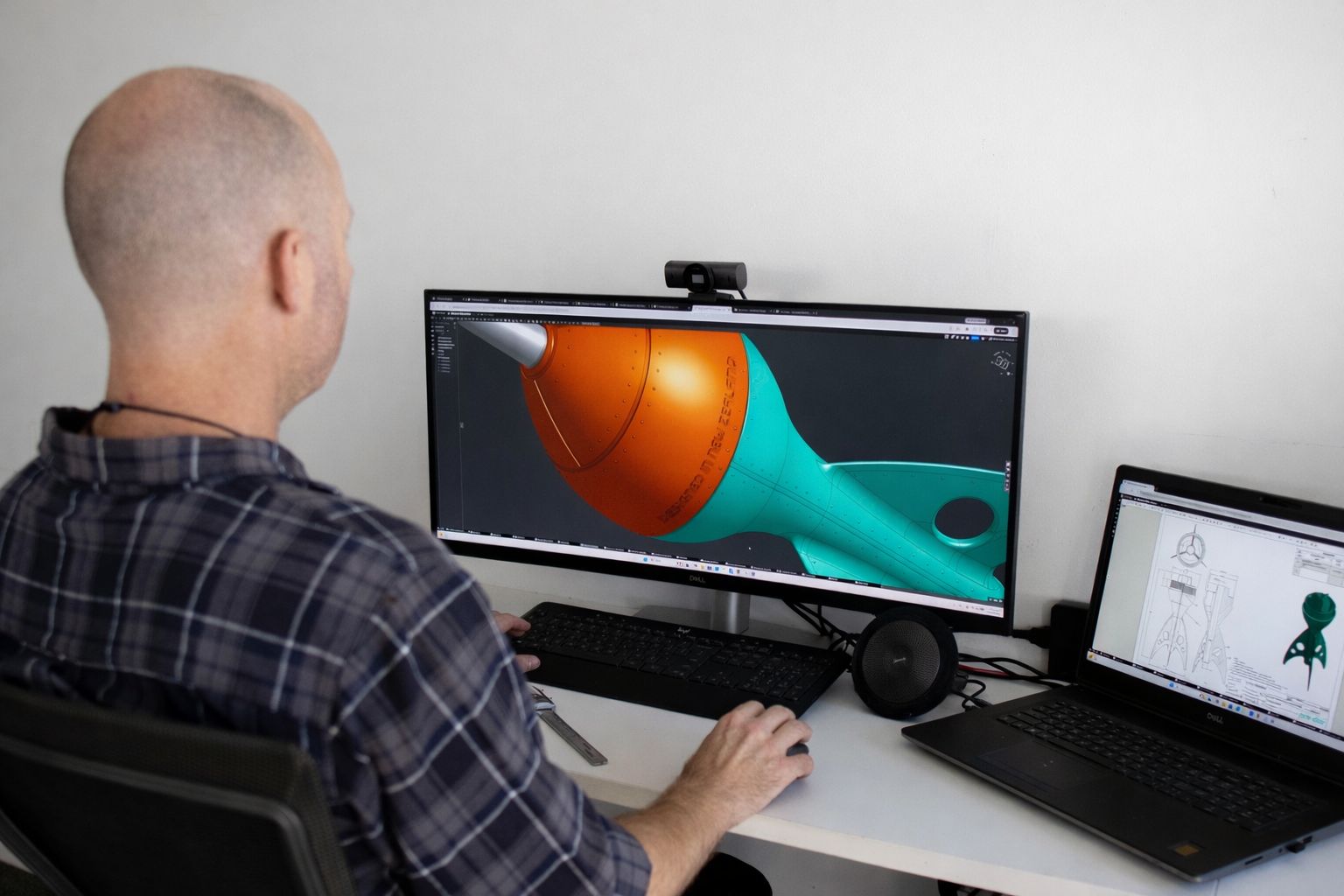
If your business regularly needs CAD work: product drawings, 3D models, technical documentation: at some point you will ask the question: should we hire someone in-house, or use an external CAD service?
The answer depends on your volume, your variability, and what your core business actually does. Here is a practical way to think through the decision.
The Case for Hiring In-House
An in-house CAD resource makes sense when your CAD workload is consistently high, predictable, and deeply integrated with your day-to-day operations. If you have a full-time flow of drawing work that needs to be done immediately and interactively: for example, a manufacturing business where drawings are being modified constantly in response to the production floor: a dedicated in-house person may be the most efficient solution.
The advantages are: immediate availability, deep familiarity with your specific products and processes, and no delay in turnaround when work is urgent.
The disadvantages are: full-time salary and employment costs regardless of workload, recruitment time and risk, the cost of CAD software licences and maintenance, training requirements when technology changes, and the risk of being left without coverage when that person is sick, on leave, or resigns.
The Case for a CAD Retainer
An external CAD retainer makes sense when your CAD workload is variable: sometimes very high, sometimes low: or when CAD is not your core business but you regularly need good quality drawings and models.
The advantages are: you pay for what you use, with predictable monthly costs; no recruitment risk or employment overhead; access to a broader range of CAD experience and platform capability than a single in-house hire; software costs are included; and the service scales up or down as your workload changes.
The disadvantages are: not immediately available for urgent same-day work without prior arrangement; requires a clear briefing process; and there is an onboarding period while the external team gets familiar with your products and standards.
Questions to Help You Decide
How consistent is your CAD workload? If you have three months of heavy work followed by two quiet months, a retainer is almost certainly more cost-effective than a full-time hire.
Is CAD a core competency of your business, or a support function? If your business value is in manufacturing, sales, or a technical service: and CAD is just what enables that: an external team that specialises in CAD may actually produce better work than a generalist hire.
What does a full-time hire actually cost? Factor in salary, KiwiSaver, annual leave, sick leave, software licences, hardware, and recruitment costs. For many NZ businesses, the all-up cost of a full-time CAD resource is significantly higher than a well-structured retainer.
What happens when your in-house CAD person leaves? Recruitment for CAD roles in New Zealand can take months. A retainer gives you continuity.
How Pro-Dev’s CAD Retainer Works
Our CAD retainer provides consistent, dedicated CAD capacity on a monthly basis. You agree a scope with us each month: a set number of hours or a defined deliverable: and we provide the resource, the software, and the expertise.
We work across SolidWorks, Onshape, Fusion 360, AutoCAD, and other platforms. We deliver in whatever format your team or factory needs. We are a professional team, not a freelancer marketplace, so you have one point of contact and consistent quality.
If you want to understand whether a retainer is the right fit for your business, the starting point is a conversation about what your CAD workload actually looks like.
If you would rather hand the modelling off entirely, our CAD services take you from concept to production-ready drawings.
