

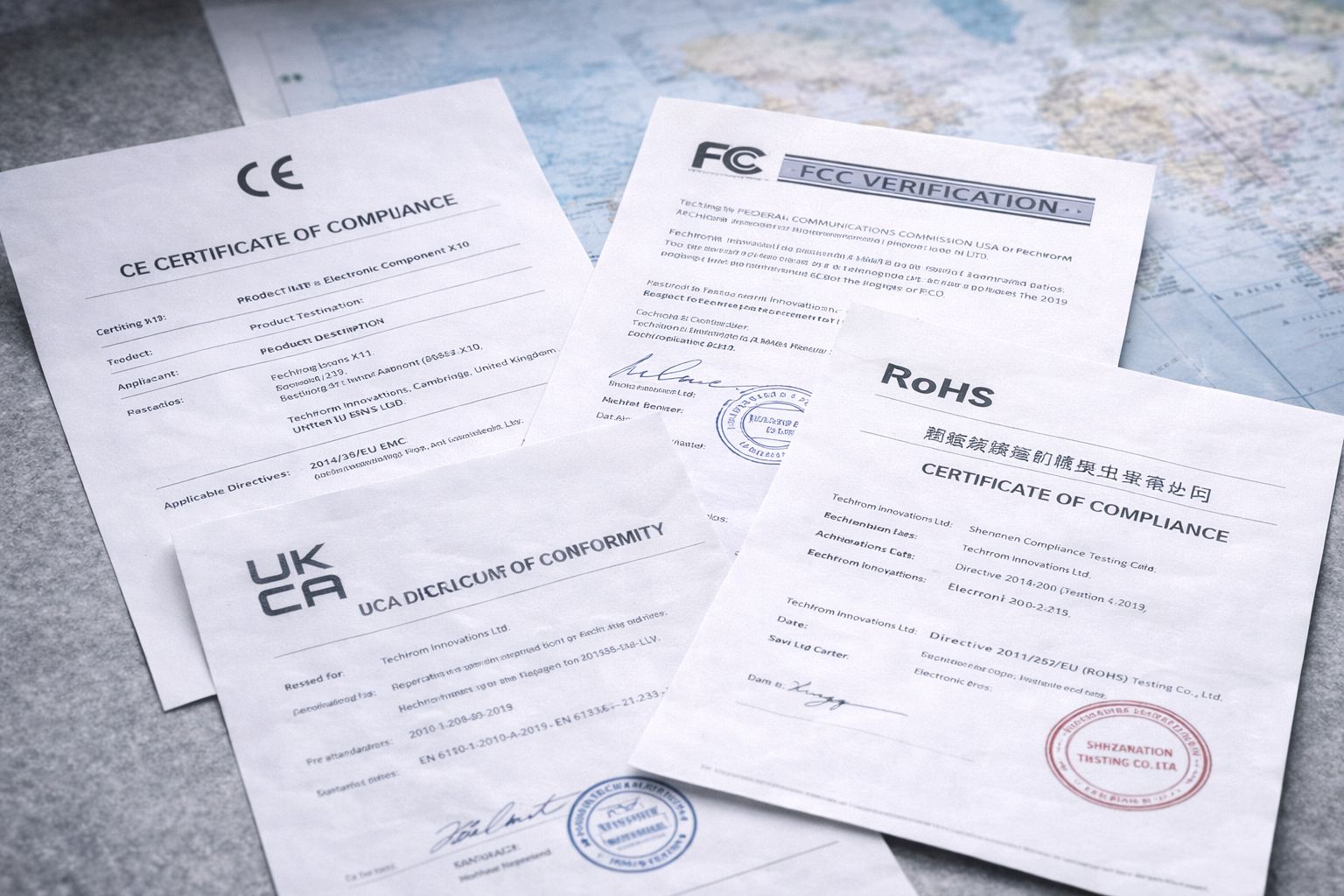
If you are planning to sell a physical product in international markets, you will encounter a range of certification marks and regulatory requirements. Here is a plain-language explanation of the most common ones.
RCM (Regulatory Compliance Mark): Australia and New Zealand
The RCM is the primary compliance mark for electrical and electronic products sold in Australia and New Zealand. It indicates that a product meets the relevant Australian and New Zealand electrical safety and electromagnetic compatibility (EMC) standards. For hands-on help with this, explore Pro-Dev’s product compliance service keeps your product on the right side of the rules.
The RCM replaced the separate C-Tick and A-Tick marks in 2016. Most electrical and electronic products sold in AU and NZ require it. The mark is self-declared by the manufacturer based on test reports from an accredited lab.
CE Marking: European Union
CE marking is required for many product categories sold in the European Union. It indicates conformity with EU health, safety, and environmental requirements. Unlike RCM, CE marking covers a wide range of product types beyond electrical products, including toys, machinery, medical devices, and personal protective equipment.
CE marking is self-declared by the manufacturer based on compliance with the relevant EU directives and standards. For higher-risk product categories, a Notified Body (an independent certification body) must be involved.
FCC (Federal Communications Commission): United States
FCC authorisation is required for electronic devices that emit radio frequency energy sold in the United States. This covers essentially all electronic products. There are two pathways: FCC Declaration of Conformity (self-declaration for lower-risk devices) and FCC Certification (for higher-risk devices, requiring testing by an accredited lab and FCC approval).
UL (Underwriters Laboratories) and ETL: United States
UL and ETL marks indicate that a product has been tested by an independent safety certification organisation. They are not legally required in most cases but are often required by retailers and purchasing organisations. Major US retailers frequently require UL or ETL listing for electrical products.
How to Navigate Multiple Markets
If you are selling in multiple markets, you need to understand the requirements for each and plan your compliance testing accordingly. There is significant overlap between standards, and testing to one standard often satisfies the requirements of another. Coordinating testing efficiently can save significant cost.
Pro-Dev manages compliance planning and test lab coordination for our clients. We work with SGS, ITS, and other internationally accredited labs and have experience with NZ, AU, USA, EU, and other market requirements.
Frequently asked questions
What is the difference between CE, FCC and RCM?
They are the compliance marks for different markets: CE for Europe, FCC for the USA, and RCM for Australia and New Zealand. Each tests different things, so a product sold in all three markets needs to satisfy all three regimes.
Do I need separate testing for each market?
Not always separate campaigns. A product designed to its standards from the start can usually be tested for all its target markets in one coordinated round, and a test report that satisfies one regime often supports another.
Which market should I certify for first?
Usually your launch market, because that certification gates your first sale. But identify the standards for every market you plan to enter during engineering, so later certifications are testing exercises rather than redesigns.
{“@context”:”https://schema.org”,”@type”:”FAQPage”,”mainEntity”:[{“@type”:”Question”,”name”:”What is the difference between CE, FCC and RCM?”,”acceptedAnswer”:{“@type”:”Answer”,”text”:”They are the compliance marks for different markets: CE for Europe, FCC for the USA, and RCM for Australia and New Zealand. Each tests different things, so a product sold in all three markets needs to satisfy all three regimes.”}},{“@type”:”Question”,”name”:”Do I need separate testing for each market?”,”acceptedAnswer”:{“@type”:”Answer”,”text”:”Not always separate campaigns. A product designed to its standards from the start can usually be tested for all its target markets in one coordinated round, and a test report that satisfies one regime often supports another.”}},{“@type”:”Question”,”name”:”Which market should I certify for first?”,”acceptedAnswer”:{“@type”:”Answer”,”text”:”Usually your launch market, because that certification gates your first sale. But identify the standards for every market you plan to enter during engineering, so later certifications are testing exercises rather than redesigns.”}}]}