

If your product has a plug, a battery or a radio in it and you want to sell it in Australia, you will meet the RCM. This guide explains what the mark actually covers, who needs it, and the practical steps from a New Zealand product company’s point of view, because we take clients’ products through this regularly.
What the RCM is
The Regulatory Compliance Mark is the single compliance mark for Australia and New Zealand. It replaced the old collection of marks (C-Tick, A-Tick and the state electrical marks) with one tick-in-a-triangle that covers both electrical safety and electromagnetic compatibility, plus radio requirements where they apply. One mark, several regimes underneath it: that is the part that catches people out. Applying the RCM is a declaration that your product meets every requirement that applies to it, not just one.
Who needs it
Three broad groups. Electrical products that plug into the mains or involve mains-level voltages fall under the electrical safety regime. Almost all electronics fall under electromagnetic compatibility rules, even battery-powered ones. And anything with a transmitter, which today means anything with Bluetooth, Wi-Fi or cellular, falls under the radio communications requirements as well. A single smart product can sit in all three groups at once.
Risk levels decide how hard the road is
Electrical equipment is classified by risk. Low-risk products can be self-declared against the relevant standard. Medium-risk products need documented evidence. High-risk products, which includes most things a consumer plugs into a wall, need certification and registration before sale. Where your product lands on this ladder is the single biggest factor in compliance cost and timeline, and it is knowable at the design stage, long before you commit to tooling.
The responsible supplier rule
Here is the detail that surprises New Zealand companies most: the RCM system requires a registered responsible supplier with an Australian or New Zealand presence. You register on the national database, your product carries the mark under your registration, and you hold the evidence file that backs the declaration. If you are a NZ company selling into Australia, your NZ entity can carry this. If you were planning to sell through a distributor, the registration question needs answering before launch, not after.
The steps in practice
The path looks like this. Identify every regime your product touches: safety, EMC, radio. Find the applicable standards for each. Design to them, which is where most of the cost is saved or lost. Test at a recognised laboratory, in Australia, New Zealand or overseas, provided the reports map to the right standards. Register as a responsible supplier, compile the evidence file, apply the mark to the product, and keep the file current as the product evolves.
None of these steps is difficult on its own. The projects that go wrong are the ones that discover a step late: a charger that needed certification, an antenna that failed EMC after the enclosure was tooled, a registration nobody owned. Compliance planned during engineering is a process. Compliance discovered at launch is a redesign, a point we make in more detail in planning compliance before finalising your design.
Selling beyond Australia
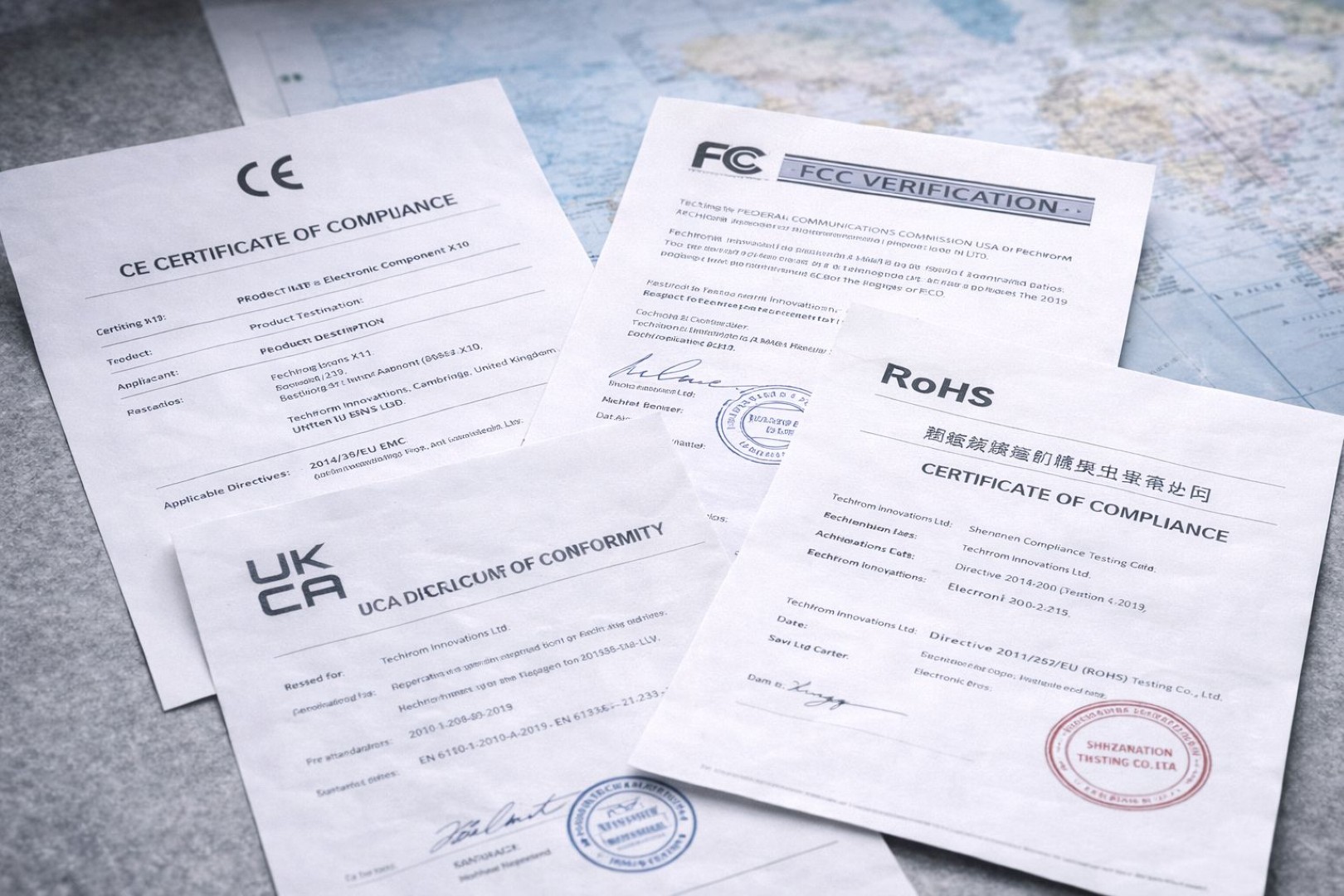
The RCM only covers Australia and New Zealand. Europe asks for CE, the USA for FCC, and each tests differently. The good news is that a product designed once, properly, can usually be tested for all its target markets in a coordinated round rather than three separate campaigns. Our global certification guide compares the three marks side by side.
Where Pro-Dev fits
We handle compliance as part of product development, not as an afterthought: identifying the regimes early, designing to the standards, coordinating the test labs and managing registration. If Australia is on your product’s map, the RCM conversation belongs in your first engineering discussions, and it costs nothing to have it there.
Pro-Dev supports product compliance across NZ, Australia, the USA and global markets. If you want to talk about your product, get in touch.
