

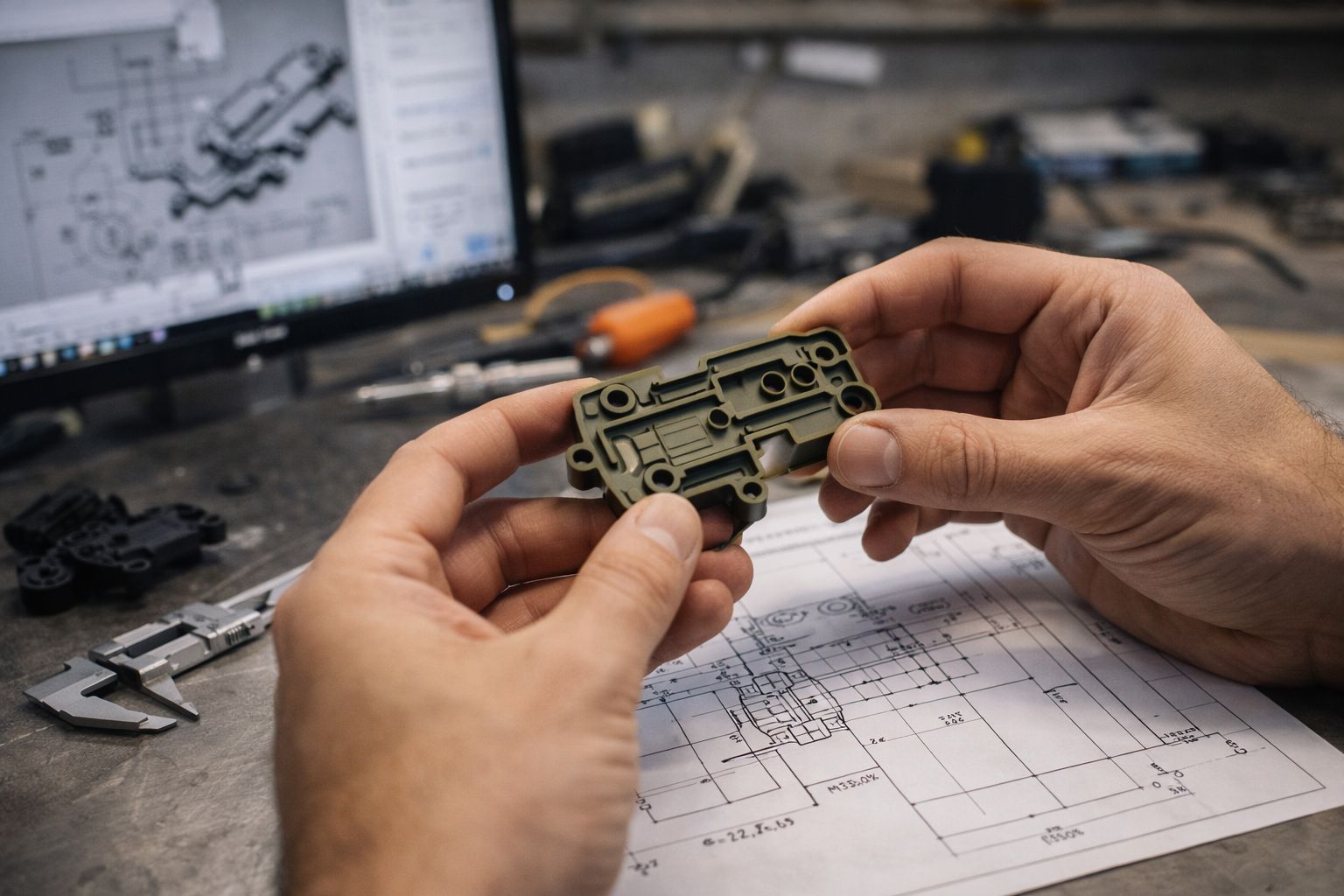
Every physical product that reaches a shelf goes through the same journey. The names change from firm to firm, but the stages do not. Miss one, or do them out of order, and the cost shows up later: a redesign after tooling, a failed compliance test a month before launch, a product that works in the workshop but cannot be built at price.
This guide walks through the seven stages we use at Pro-Dev, what each one is for, and where projects most often go wrong.
Stage 1: Idea and definition
Everything starts with a problem worth solving. The mistake at this stage is jumping straight to what the product looks like. The better question is what the product must do, for whom, and at what price.
A good definition fits on one page. It covers the user, the problem, the target retail price, the markets you want to sell into, and the three or four things the product absolutely must do. That single page becomes the reference point for every decision that follows.
Write the target price down early. It drives more design decisions than any other number.
Stage 2: Research and feasibility
Before spending money on design, find out whether the idea survives contact with the real world. That means three checks.
Market research: who else sells something similar, at what price, and what do their customers complain about. The complaints are gold. They tell you what the market wants fixed.
Technical feasibility: can this actually be made with current materials and processes, at a cost that supports your retail price. A quick feasibility review by an engineer costs little and can save a fortune.
IP position: run a prior art search before you fall in love with the idea. If someone already holds a patent on your core mechanism, better to know in week two than in month twelve. This is also the point to think about protecting your own idea before you start sharing it.
Stage 3: Concept and industrial design
Now the product takes shape. Industrial design covers how the product looks, how it feels in the hand, and how the user interacts with it. Good industrial design is not decoration. It decides whether someone picks your product up in a store or scrolls past it online.
Expect several concepts at this stage, not one. Rough sketches first, then refined renders of the strongest direction. The output is a design the whole team agrees on before engineering begins.
If you are unsure how this differs from the engineering that follows, we cover it in industrial design vs product design.
Stage 4: Engineering and CAD
Engineering turns the agreed concept into something that can actually be manufactured. This is where the product gets its internal structure: wall thicknesses, fasteners, tolerances, material selection, and the detail that decides whether parts snap together cleanly or rattle.
The single most valuable habit at this stage is design for manufacture. Every feature gets assessed against how it will be moulded, machined, or formed. A part that is elegant on screen but needs a four-piece tool is not elegant. It is expensive. We explain the thinking in what is DFM.
The output is a full 3D CAD model and manufacturing drawings. Done properly, a factory on the other side of the world can quote from this pack without a single clarifying question.
Stage 5: Prototyping and testing
A prototype exists to answer questions. Does it fit the hand. Does the mechanism survive a thousand cycles. Does the lid seal. Each round of prototyping should test something specific, learn from it, and feed the answer back into the CAD.
Expect more than one round. Two or three prototype cycles is normal for a consumer product. The cost of a printed prototype is trivial next to the cost of modifying steel tooling, so the rule is simple: find the problems in plastic, not in production.
This is also where you put a prototype in front of real users and watch them use it without instructions. What they do wrong is your best design feedback.
Stage 6: Compliance and certification
Every market has rules. Electrical products need certification. Products for children have their own standards. Australia, the USA and Europe each ask for different marks. None of this is optional, and all of it is cheaper when planned early.
Compliance gets expensive when you leave it too late. A product designed without the target standards in mind can fail testing in ways that force a redesign, new tooling, and a missed launch window. The fix is boring and effective: identify the standards for every target market during engineering, and design to them from the start. Our global certification guide covers CE, FCC and RCM in detail.
Stage 7: Manufacturing and beyond
Finding a factory is easy. Finding one you can trust is not. Production is where eighteen months of good work either pays off or unravels, and the difference usually comes down to three things: a factory that was vetted properly, a quality control process that inspects before goods ship, and someone on the ground who speaks the language.
Plan for a pilot run before full production. A few hundred units will surface assembly problems, packaging problems and logistics problems while they are still cheap to fix.
Launch is not the finish line either. Warranty feedback, small design improvements and cost reductions carry on for the life of the product. The products that win are the ones that keep improving after version one.
How long does all this take
For a typical consumer product: three to six months from idea to a production-ready design, then two to four months through tooling and first production. Electronics and certified products run longer. Anyone promising a serious product in eight weeks is skipping a stage, and you will find out which one later.
The stages are not strictly linear. Prototyping feeds back into engineering. Compliance shapes design. But the sequence matters: money spent early on definition, research and DFM is the cheapest money you will ever spend on your product.
Your product gets one launch. The stages exist so you get it right the first time.
Pro-Dev takes products through every stage under one roof: design, engineering, prototyping, compliance and manufacturing through our own supply chain in China and New Zealand. If you want to talk about your product, get in touch.
For hands-on help with this, explore Pro-Dev’s product design and development service guides each stage from idea to production.
