

Industrial design is barely a century old as a named profession, yet it has reinvented itself at least four times. Each reinvention changed what designers do, what tools they use, and what the public expects a product to be. Understanding that evolution is useful for anyone developing a product today, because the forces that drove each shift are still at work.
The beginning: design meets the production line
Industrial design was born when mass production created a new problem. Factories could suddenly make thousands of identical products, but the products were designed by engineers for the machine, not for the person buying them. In the 1920s and 1930s, figures like Raymond Loewy and Henry Dreyfuss built a new profession around a simple idea: products made for everyone should be designed for everyone.
This first era gave us streamlined trains, sculpted radios and the notion that the look of a product sells it. It also established the core tension the discipline still manages today: the balance between what manufacturing can do cheaply and what people actually want to own.
The functional era: form follows use
After the Second World War, design matured from styling into problem solving. The German school led by Dieter Rams at Braun stripped products back to their function. Good design became defined by usefulness, honesty and longevity rather than decoration. Rams’ ten principles of good design, written half a century ago, still read like a checklist a design team could use this morning.
The lasting shift from this era was ergonomics. Designers began measuring hands, reach and eyesight, and products started to fit people rather than the other way around. Every comfortable tool grip and every legible control panel traces back to this period.
The digital revolution: from drawing board to CAD
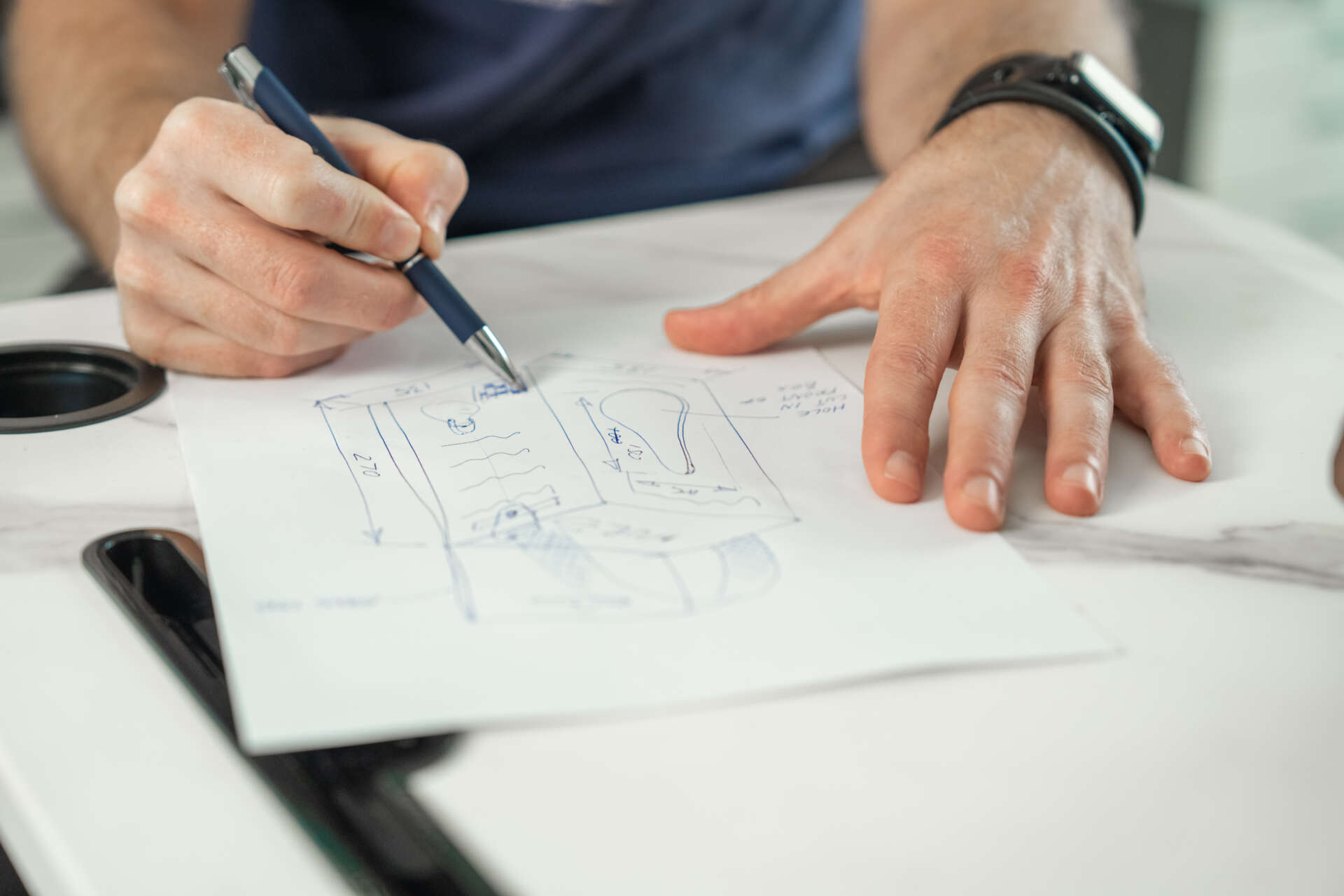
Until the 1980s, a product existed as ink on paper. A single design change could mean redrawing dozens of sheets. Computer-aided design changed the economics of the entire profession. A change that took a week on the drawing board takes minutes in 3D CAD, and the same model that describes the shape also drives the mould, the toolpath and the assembly drawings.
CAD did something subtler as well. It moved industrial design and engineering onto common ground. When the designer’s surface model and the engineer’s structural model live in the same file, the old wall between the studio and the workshop starts to disappear. That overlap is now where most good products are made, and it is why the distinction between the two disciplines confuses so many people. We explain the difference in industrial design vs product design.
The prototyping leap: ideas made physical overnight
The next reinvention came from 3D printing. For most of the profession’s history, testing an idea meant weeks of model making. Now a designer can hold yesterday’s idea in their hand today. That speed changed the process itself: more ideas get tested, more mistakes get found early, and the gap between concept and confident decision keeps shrinking.
The practical effect on product development is hard to overstate. Prototyping used to be the expensive, slow stage that teams rationed. It is now so fast and cheap that skipping prototype rounds is a false economy. The rule at Pro-Dev is simple: find the problems in plastic, not in production.
Where industrial design is heading
Three forces are shaping the current era.
Sustainability has moved from talking point to design requirement. Material choice, repairability and end-of-life recycling are now decisions made at the CAD stage, not claims added by marketing. Regulation in Europe and Australia is pushing the same direction, and right to repair is gathering momentum in New Zealand.
Software is entering physical products. A growing share of products are part hardware, part app. Industrial designers now shape experiences that span the object in your hand and the screen in your pocket, which pulls the discipline closer to user experience design every year.
Manufacturing knowledge is becoming the differentiator. Tools keep getting easier, which means a good-looking concept is no longer rare. What separates products that launch from products that stall is design that respects the factory: realistic tolerances, sensible material choices and costs that work at the target retail price. The designers who thrive are the ones who understand manufacturing deeply, which is the thinking behind our own industrial design service sitting inside a manufacturing business rather than beside one.
What this history means for your product
Every era of industrial design added a discipline that today’s products are judged against. From the first era, appeal: your product has to make someone want it. From the functional era, usability: it has to work for real hands and real habits. From the digital era, precision: it has to be defined well enough to manufacture anywhere. From the prototyping era, proof: it has to be tested before tooling. From the current era, responsibility: it has to justify its materials and its lifespan.
A century of evolution compresses into a short checklist, and the products that win are the ones designed against all of it from day one. If you are starting that journey, our guide to the stages of product development shows how these disciplines fit together in practice.
Pro-Dev provides industrial design, engineering and manufacturing under one roof, with our own supply chain in China and New Zealand. If you want to talk about your product, get in touch.
